Sunday, May 4, 2014

Spin the Conversation

Advanced Conversation "401" requires skill and practice.  This is a technique of almost infinite volleying.

Inevitably a subject matter in the conversation begins to wane - "run out of gas".  In tennis the volleys become weaker and harder to hit. If you are unprepared silence hits and both players stand stunned without a clue of where the subject ball has landed.  Without the ball (new subject) there is no chance of play. 


A great conversationalist can anticipate this and spin the subject into a brand new conversational volley.  The key to this technique is careful listening to associated subjects casually refereed to by the other player.  Example:

Suppose you served up the vacation subject: "Where are you going to vacation this summer?"  During the volley of responses the other player mentions the challenges of air travel to Europe.  As the subject begins to fade you might ask:  "What do you do to try to avoid jet lag?" or "What's you favorite and least favorite Airline? (nearly everyone will have a slew of travel stories).

Once you start spinning into new subject manners your conversational partner may start spinning subjects back.  This can be a very enjoyable advanced game. 

Saturday, May 3, 2014

Body Language in Play

It's not only your questions or responses that will determine conversational success, it's how you look, move and react to the play that will also assist you in minimizing conversational stress. Like tennis, conversational concentration is critical to keeping the "ball in play". You must listen deliberately and intently in conversational flow - it's not just about preparing you next question or response. Interrupting the other player can also disrupt their stroke and play. It is normal for your mind to wander - the verbal speed of return conversation is a snail's pace compared to the speed of your brain in processing the information. Don't let this mismatch of pace disrupt your nonverbal actions - eye contact and body movements.

Eye contact is critical - focusing on the other player's eyes will tell them you are interested in what they are saying and it will aid in your listening concentration.  Nodding can communicate both interest and encouragement for the speaker to continue on their conversational path.  Even looks of intrigue or puzzlement can create a non-verbal clue to the player that you want more information. 

A smile can do wonders in conversational success.  A smile shows your receptivity for continuing dialogue.  Acknowledgement of wit and humor puts both parties at ease and sets a positive tone for continuity - within the subject discussed and for new topics of potential interest.

Your feelings of comfortable conversation will be contagious to even the most laconic player.  Showing non-verbal openness will also reduce your conversational stress. Remember you are looking into a conversational mirror - if they look stressful then likely you are stressful also.  Take a deep breath, smile, nod approvingly and focus your eyes - watch what happens immediately.

Over thinking is like "over stroking" and will disrupt your flow.  Get your body in control and the flow will come naturally.


Friday, May 2, 2014

Return and Volley - Conversation Continuity

In my last blog I mentioned the conversation analogy to tennis and introduced the "first serve" question.  A good conversation though depends on partnership returns and volleys.

While the initial serve is important, it could be the serve went wide and a weak or non existent return came back (e.g. a one sentence response with a long silent pause). Don’t panic but be prepared - a good "first serve" can anticipate a weak return (Remember #3 in the last blog - Pick a subject and question that has natural and easy follow-on questions).

At this point you have two options – let the subject go and re-serve or attempt the volley. My preference (if the ball didn’t go into the net) is to attempt the volley.

There are two types of Volleys:


A. Immediate Volley – no bounce (when you have the least desire to talk):

Immediate Volley - Tell me More

(1) “Tell me more” - Say only those three words and out wait the uncomfortable silence
(2) Why …. Why did you …. Why not.
(3) “That’s interesting how did you decide that”?
(4) “I’m not sure I understand could you explain what you meant about ….
(5) “What was your thinking?
(6) “Who else was with you?


B. Standard Volley – you talk and give the other person time to collect their thoughts. Remember they may be just as stressful as you at conversational play. If the other player is a cooperative conversationalist and the volleys look easy then take your time and help extend the volley with sharing your own information. Reveal some related information about the subject (or yourself) and prepare a methodical smooth follow-on.


Respond and Prepare a Smooth Follow Through

Here are some suggested conversational fillers giving the other player time to think:

(1) “Same with me … I ……
(2) “ I agree … for me it’s like …….
(3) “I had a similar experience when ….
(4) “That’s exactly like the time I …….


Now prepare your stroke and smoothly follow through with another question:

(1) What else do you remember about ……
(2) How did you feel when ……
(3) Was that the first time or has this happened before?
(4) Why did you …..

Notice the follow on question attempts to understand their thinking, feeling, memories, other related experiences. Like a detective you are probing for more information. Done correctly it proves you are listening intently to their response and want to keep the ball in play.

Above all - remember to calmly and methodically enjoy the conversational rhythm of the volley. 

Thursday, May 1, 2014

Conversation Serves

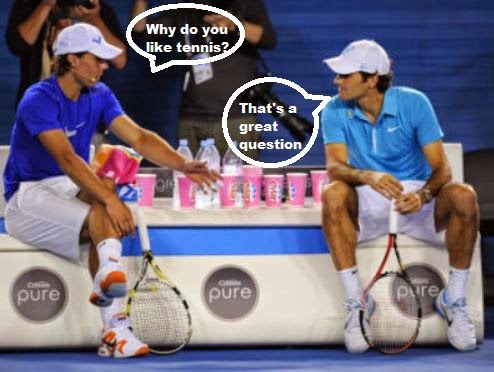
Conversations can at times be like the game of tennis –with one exception, the goal is to keep the volley going. A good first serve can be the key to success. Remember you aren't trying for an ace - you want the ball to come back.

What first question will create a sustainable long volley?

The goal of the first question is to find an interesting topic or theme that “keeps the ball in play”.  

Here are some characteristics of a good “first serve”:

(1) Open ended questions – Try to ask questions that DO NOT require one word (Yes/No) or one sentence answers. Start the question with “Tell me …; “Explain …; “How do you….; Why do you .....;
(2) Ask about the person – Usually everyone likes to talk about themselves
(3) Follow-on clarification – Pick a subject that has natural follow-on questions
(4) Keep to non controversial subjects

So here are some sample first serves:
 
Tell me what a typical day for you is.
Could you give me advice on how to ….
What do you like about your job?
If you could live anywhere where would you choose?
What do you do to stay so fit?
Why do you like …….?


Wednesday, April 30, 2014

Change

Professor Zelikow (University of Va) in his lecture "The Emerging Governance Gap" said >  "People don't change unless they think there is something better in its place".  I used this quote recently in our SVP Cincinnati consulting session with Su Casa  (Non Profit assisting Hispanic population in Cincinnati).  Change is tough and requires a positive attitude when it is forced upon you.

Life circumstances outside your control will pressure you to change.  You can either accept that change or resist it.  Envisioning the positive and accepting/coping with the negative is a first step in creating the necessary attitude in the change management process.

The world (and it's history) shows one certainty - that change will happen.  It can either happen with you or without you.  What you can control is how you deal with the change.

Tuesday, April 29, 2014

Graduations

What a moment in time - Jenna is now officially graduated from University of Cincinnati College of Nursing.  While I must admit attending any graduation ceremony (listening to over 2000 names being read) can be tedious, looking back on it I'm glad Jenna wanted to attend.  The "Pinning Ceremony for UC Nursing" was an added two hours but worth it.  Learning that UC's College of Nursing is the OLDEST accredited Nursing program is quite a heritage for Jenna to be a part of. 

Sunday we moved Jenna out of the Clifton poverty and she will transition from our house to her own abode once she finishes her Nursing accreditation test and starts at Christ Hospital in oncology.  The month of May will be a spring into new adventures.

Today was my own "graduation" having finished the last quiz and survey for the 14 week history course (92 lectures) I was taking on-line.  I have earned the Distinguished Student Award (85% or higher on the cumulative quiz scores).  I have enjoyed this more than the library videos "Great Courses"  (www.thegreatcourses.com). 

So in a small way, I join Jenna in graduation.  She however was "Cum Laude".  Well done Jenna!!  You surpassed my college performance.  Good to see the generations improve.  :)

Monday, April 21, 2014

Easter Season

Yesterday was a wonderful  Easter Sunday. A sunny 70 degree day that the family and A.M. spent outside.  There were activities with Badminton and even flying kites.  The new "dog water fountain" has been installed.  With the soft sound of water bubbling and the wind chines echoing, our back patio has transformed into a spring time oasis.